
by m93718 | Jun 19, 2023 | Facilitation Tips
Photo by Glenn Carstens-Peters on Unsplash
Today’s blog post is by Allison Khaw
When the COVID-19 pandemic first hit, we all had to learn how to work remotely as we also navigated major losses and disruptions in our professional and personal lives. Now that the public health emergency is officially over, we still have to navigate a range of new workplace challenges. One of the big ones today: hybrid meetings.
Handling the transition from conference rooms to video calls wasn’t easy, and hybrid meetings take that difficulty to a whole new level. In fact, I know colleagues who go out of their way to avoid leading hybrid meetings, choosing instead to organize entirely virtual or in-person meetings. It’s not hard to see why!
A hybrid meeting (which could range from a working session to a presentation to an event) is the epitome of “high risk, low reward”—if it goes well, the organizer rarely receives formal recognition, but if it doesn’t go well, that’s the first thing that everyone notices. No wonder most people would probably say “good riddance” to holding hybrid meetings, if offered the choice never to do so again.
And yet, I would argue that we don’t really have that choice anymore.
Among other changes that COVID-19 introduced, the workforce of 2023 has a strong emphasis on flexibility and work-life balance. Many teams are geographically distributed across the globe, where only a subset of the team may be co-located. Even if everyone works from the same location, it’s likely that at least one person will need to join remotely for any given meeting. Sure, fully in-person or virtual meetings will continue to occur as well, but occasional hybrid situations are inevitable. The times are changing, after all, and we should adapt with them. (We may even ask ourselves the question, Should We Be Muting Our Sneezes?)
Like them or not, hybrid meetings are here to stay.
Despite the challenges, hybrid meetings might give us the best of both worlds. Attendees in the room can feel rejuvenated by in-person human interaction and the work culture that this promotes, while remote attendees are guaranteed a virtual seat at the table. In-person and remote attendees also get to connect with each other. In many ways, hybrid meetings lie at the intersection of modern technology and flexibility, lighting up a path for us to explore what’s possible.
I suggest it’s better to embrace hybrid meetings—and learn how to hold them successfully—than to keep them at arm’s length, perpetually afraid that they’ll “bite.”
We can achieve success by adopting small yet mighty habits that enable team inclusion and productivity in our hybrid meetings. This is an area where the “diffusion of responsibility” can be especially harmful, because the responsibility to demonstrate our awareness through our actions actually lies with each and every one of us. We need to consciously put ourselves in other attendees’ shoes, ensuring that our behaviors are conducive to everyone in the meeting.
So let’s take action! Here are some tips for holding successful hybrid meetings:
- For remote participants:
- Be intentional about making your presence known. Periodically remind others of your virtual presence by making your opinions heard. Consider turning on your video or asking those in the room to do so as well. Use common sense for when to speak up, but don’t hesitate to speak up. If you’re a seasoned teleworker, you can teach other remote participants about the best practices that you’ve learned firsthand.
- Avoid the temptation to get distracted or “fade” into the background, depending on the situation. Know your own goals for each hybrid meeting ahead of time—do you want to be a more active participant or a passive observer? Sometimes the latter is acceptable, but it’s up to you to choose wisely.
- For in-person participants:
- Remember the power of the room microphone. Anything from whispered side conversations to the crunch of chips can make it hard for remote attendees to hear. Know where the room microphones are located, or better yet, keep the conversation threads to one.
- Be rigorous about bringing all voices into the conversation. Occasionally ask, “Does anyone online have anything to add?” and then allow for longer pauses than you may be used to. This invitation gives remote attendees the chance to unmute and share anything that they couldn’t earlier. Also, ensure that at least one in-person attendee can see the meeting chat, so that no comments are overlooked.
- Consider stating your name before making your point. In a hybrid meeting where not everyone knows each other, get into the habit of starting with, “This is [insert name], and I think that…” Doing this for even the first ten minutes of a meeting can help remote attendees identify your voice, making a world of difference.
- Take physical actions that will be inclusive to the remote attendees. This may include using a virtual whiteboarding tool rather than writing on a physical whiteboard, or situating yourself in the camera’s line of sight rather than sitting in its blind spot. All of this translates to “I value your presence.”
- For the meeting organizer:
- Test out your meeting technology ahead of time to set yourself up for success. Consider doing a dry run of the technology a day early or officially starting your meeting five minutes after the hour in order to deal with any technical issues. That being said, sometimes unexpected issues do arise, so make sure you’ve planned for contingencies.
- Demonstrate strong facilitation skills. No matter what kind of hybrid meeting you are leading, recognize that it’s your role to guide the team in the right direction. At the same time, you don’t have to do everything alone: consider delegating roles to others, such as a meeting chat monitor or a designated moderator.
- Prioritize inclusive behaviors. If not everyone has met each other before, spend the time to do introductions for in-person and remote attendees. Consider leveraging Innovation Toolkit facilitator best practices, such as the question, “Who have we not heard from?” and the improv technique, “Yes, and…” to build on each other’s ideas. For better collaboration, encourage attendees to turn on their cameras during the meeting.
- Clearly communicate meeting guidelines and schedule changes. Prepare an agenda and objectives ahead of time, and set expectations at the start of the meeting. This includes being deliberate about stating the preferred way for remote attendees to participate, such as “speak up at any time” (assuming the meeting size allows for this) and “raise your virtual hand”. For any agenda adjustments or impromptu breaks, share start and end times both verbally and in the meeting chat.
- For everyone:
- Give each other grace. Respect that everyone is trying their best, especially since hybrid meetings comprise a space that’s not yet fully explored. If you notice that the meeting organizer isn’t implementing some of these actions that you think would be helpful, step up and act as a role model. Everyone needs a reminder sometimes, after all.
We’re at a pivotal moment in time to shape the future of hybrid meetings. If we don’t embrace them for all that they’re worth, we may lose an opportunity that we have in our professional lives to shine, whether from the conference room or from our computer screens—ideally, from both. Take this as your call to action to start leading the way!
by m93718 | May 16, 2022 | Facilitation Tips, Tutorials |
This week’s blog post is by Kerrianne Marino
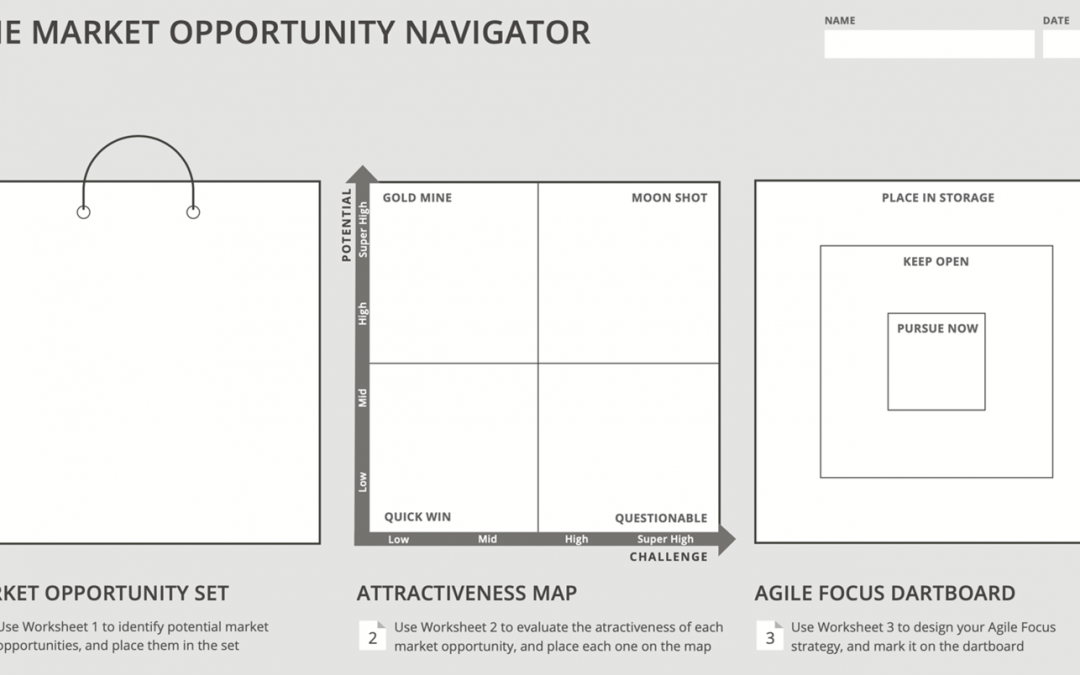
The Market Opportunity Navigator is a set of three tools that help project teams ideate, organize, and strategize their market opportunities. Created by “Where to Play,” it is designed “to help [teams] get a clear overview of [their] potential market domains and make confident decisions on where to play next.”
While “Where to Play” focuses on business strategy goals, these tools can aid discussions on which research topics, proposals, areas of interest, or other ideas the group should pursue.
The “traditional” method as outlined on the Market Opportunity Navigator is only one option to put these tools in practice. I adopted the Agile Focus Dartboard and Attractiveness Map in a slightly different way recently during an ITK session. Regardless of the approach, establishing action items at the end of any session is essential in setting ideas into motion!
In practice – Agile Focus Dartboard & Attractiveness Map
In a recent ITK session I facilitated, 3 groups of 3-4 worked together to brainstorm goals for 1, 3-5, and 10 years for a new software wellness initiative that aimed to transform how MITRE approaches “healthy” software development by creating an inclusive community and collection of resources. We used the Agile Focus Dartboard as a visual aid for the groups to note the area of focus they should be brainstorming in.
The year 1 group was the “pursue now” section, and they were tasked with brainstorming initiatives that the team could start on right away. The 3-5 year group was “keep open,” where they came up with ideas that could come into play, or be “launched” several years from now. The 10 year groups was “place in storage,” and they thought of the practices, resources, and culture shifts that they hoped MITRE would lead a decade in the future. While these substitutions aren’t exact matches for the listed categories, they gave context for the groups to work toward.
In the smaller groups, the teams brainstormed for 20 minutes on dry-erase laminate cards (an alternative for sticky notes), and placed their thoughts on an appropriate quadrant in the Attractiveness Map.
We then discussed in turns all three Attractiveness Maps in a larger group to consider and include other’s opinions on where the ideas would fall in the quadrant based on experience. For example, we thought about the lift that research proposals would take in the year 1 timeframe. Originally, we thought this idea would be a quick win, but when discussing with the larger group, we moved this to a gold mine.
Example: Culture Change – Act Now for Later?
Because we were starting a brand new wide-spread initiative that aims to change how engineers at MITRE work, culture change was a big topic that all three groups discussed. When we came together, we agreed that it would fit into something to pursue now, even though we may not see the change for 3-5 or even 10 years.
Year 1 identified this culture shift as a moon shot, and the 3-5 and 10 year as somewhere in the middle of the quadrant. We knew if we didn’t start acting on culture-changing efforts now, this culture shift would delay, so we made action items in “year 1/pursue now” to initiate the kind of practices that will drive the desired long-term changes. For example, the group considered using incentives like small company awards as an immediate “low challenge, medium potential” option to catalyze this culture change.
Our Take
While the Market Opportunity Navigator was designed for business goals, our Software Wellness Center initiative team was able to tailor and adopt this strategy to our goals of providing the best services for software developers to develop healthy software for all.
If you’d like to give it a try, here’s a quick summary of the steps involved:
- On a large whiteboard, draw out the Attractiveness Map
- Organize groups of 3-4 people per group in each category in the Agile Focus Dartboard (Pursue Now, Keep Open, Place in Storage)
- Have the Agile Focus Dartboard on display as a visual aid to show participants where their group lands
- Give participants sticky notes and ideate for 20 or so minutes, placing items in their associated quadrant
- Come together as a group to share out each board and iterate based on team feedback
- Set action items to put ideas into motion!
Alternatives
- The “traditional way” (see steps on Market Opportunity Navigator). Ideate first, then place stickies on Attractiveness Map, then place stickies on Agile Focus Dartboard
- Hand out or have on display the Attractiveness Map and/or Agile Focus Dartboard as a visual aid to focus brainstorming discussions. For example, you could use the Lotus Blossom tool to ideate only ideas that would be Gold Mine’s that the group could Pursue Now.
by m93718 | Mar 22, 2021 | Success Stories, Tools 101
This week’s post is by Gabby Raymond
My husband, Ben, and I are at that happy stage of life where we are looking to buy a house together. What started off as a joyful hobby now feels like a full-fledged part-time job full of anxiety, anguish, and frustration. Those of you who have bought a house, especially in a market as hot as Boston is right now, probably know our pain. For the unenlightened, our house buying experience has been akin to proposing marriage to someone after your first blind date – equal parts fear, excitement, and “wow, this could cost me dearly if it goes poorly.”
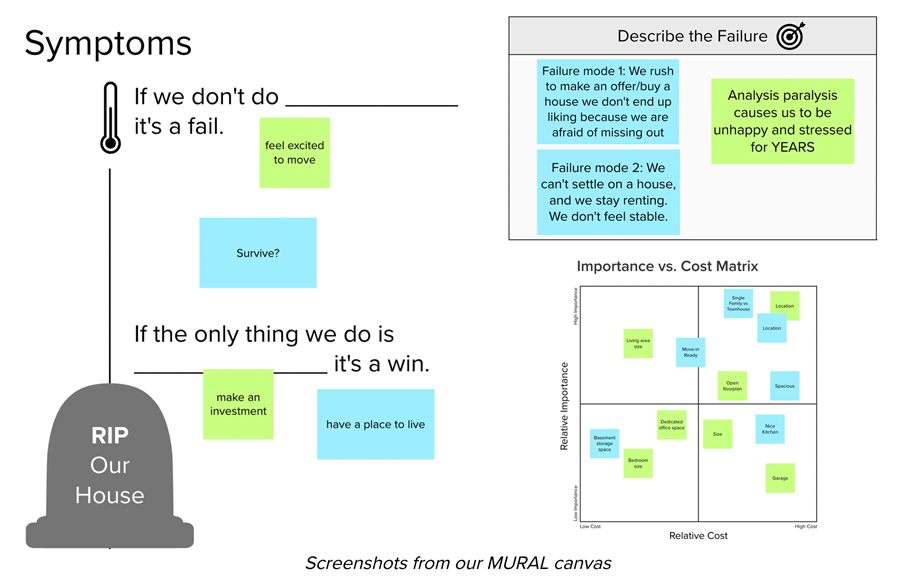
Since training to become an ITK facilitator, I have found plenty of opportunities to apply ITK tools to my everyday life. After a particularly stressful open house where Ben and I were debating the merits of replacing our home search hobby with a home improvement hobby, we began to worry we would never actually buy a home. Over dinner and some beer, I told Ben I wanted to try out a Premortem with him. His first response was, “Premortem, is that when you kill me before we start?” After a good laugh, I described the tool to him: we’re preemptively trying to understand what failure looks like by describing a particularly bleak future (the bleaker the better), identifying the causes, and coming to a consensus on what success looks like. Sounds easy, right?
I realized after the open house that Ben and I had done a poor job communicating our individual goals because we were too worried about disagreeing. We needed to get everything out on the table. I set us up on different computers in different rooms to use MURAL, an online whiteboarding tool, to fill out a Premortem canvas. I used MURAL’s incognito mode to make sure we didn’t bias each other’s contributions. After 10 minutes of quiet working time, we cozied up on our couch together to discuss our canvas. Right away, we confirmed something we already knew – we were both tracking to the needs, desires, and goals of the other person. However, there were a few things that were surprisingly different.
Our biggest divergence was when answering the most important question on the canvas, “If the only thing we do is ______, it’s a win.” His answer – have a place to live. My answer – make an investment. It was a great dialogue point for some of the stress and anxiety we’d each been feeling. He was worried about the stability of having a house versus being at the will of a landlord. I was concerned that after years of saving up for a down payment we would purchase a house that would go down in value and flush our investment down the drain. Neither of us had vocalized those concerns directly, so it was helpful to talk openly.
We wrapped up the Premortem canvas by describing three failure scenarios and risk mitigations. It was refreshing to go from doom and gloom to planning for future successes. After the Premortem, we took our key house features and plotted them on a Cost x Importance matrix. Just like the Premortem exercise, the differences in our answers led to great conversations about tradeoffs and compromises.
Ben and I found our whiteboarding exercise to be valuable, both because we confirmed that we agree on the important aspects of our house search and because we came to a consensus on what success looks like in the big picture. We used MURAL’s incognito mode to foster clear dialogue without the concern of compromising in the moment or biasing each other’s opinions. In the end, framing of the conversation was just as important as the content.
We haven’t bought a house yet, but we know what we’re looking for… at least a little better than we did before!
by m93718 | Mar 8, 2021 | Keeping up with the team, Misc Awesomeness
Today’s post is by Allison Khaw!
Can a diverse group of seven engineers and designers write a book? Can they write a book about innovation, teamwork, and problem solving, in a collaborative fashion, while working in a virtual environment?
The answer is yes.
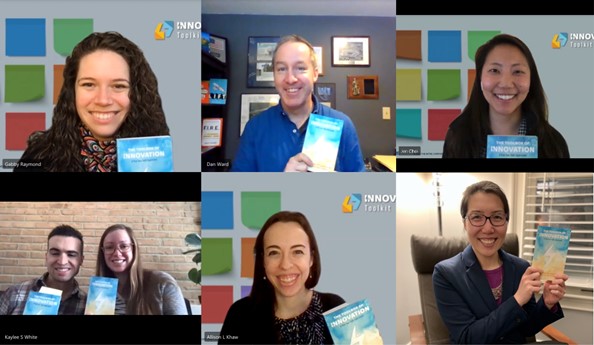
In fact, that’s exactly what seven of us on the MITRE Innovation Toolkit team did this past year! Fresh off the press, our book is called The Toolbox of Innovation, and we—Jen Choi, myself (Allison Khaw), Gabby Raymond, Dan Ward, Kaylee White, Niall White, and Jessica Yu—couldn’t be more excited to share it with the world.
As the first line of the book says, it was an experiment. We didn’t know how our book would turn out, or if it would turn out. There was only one way to know the answer, and that was to sit down and start putting words on the page.
We used a writing style similar to the “Choose Your Own Adventure” books that were popular in the eighties and nineties, except that we placed our characters in a real-world setting. You—the reader—are the protagonist of the story, which revolves around a passionate team applying innovation methods to develop a product that will delight its users. Depending on the path you take through the book, you’ll learn about intrapreneurism, self-advocacy, problem framing, prototyping, failure, and more. If you encounter a dead-end in your current path, simply turn around and make a different choice.
 Throughout the writing process, we focused on ways to be more collaborative and creative. We took on the scenes we were most passionate about, learning firsthand that messy first drafts are inevitable. We edited each other’s scenes without feeling like we needed permission. As our book took shape, we incrementally built our cast of characters and mapped out the myriad plot threads. We also learned about self-publishing and the effectiveness of fiction in teaching real-world lessons. Ultimately, it was an exercise in shared leadership as well as a refreshing opportunity to embrace risks.
It was an incredibly rewarding experience, in more ways than one.
One of my favorite parts of our book is its playful nature. You’ll find scenes involving Bigfoot, failure cake, juggling, and alternate endings, not to mention a suspiciously large number of potato chip references. (You’d think we were sponsored by a snack food company—nope, our characters just really like chips!) Each of the co-authors brought a different perspective to the table, and we’ll be finding ways to share our experiences and lessons learned, starting with this blog post. We want to help you perform your own experiments, in all their glory.
Now, what are you waiting for?
If you want to find out more, go to The Toolbox of Innovation
If you are undecided, mull it over and then re-read the previous line
When you’re ready, turn to the first page of the book, and take the story where you will. It’s your adventure, after all—you get to call the shots.

by m93718 | Feb 22, 2021 | Uncategorized |
This week’s post is by Allison Khaw. Photo by Mika Baumeister on Unsplash.
I was sitting at my desk recently, participating in a virtual work meeting, when I sneezed.
I was already muted, so the meeting continued without pause, but this got me thinking. As a side effect of our current behavioral norms, we are effectively subduing those idiosyncrasies that make us human. Returning my gaze to the computer screen, I mused to myself: Should we be muting our sneezes?
I still chuckle at the inexplicable absurdity of this question—muting our sneezes, who would have thought!—but I also ask it with a genuine yearning to understand the answer. And the true question, as you may have guessed, extends beyond sneezing. Before COVID-19 upended our work culture, we lived in a time where in-person meetings were more common than hybrid or virtual ones. The paradigm has shifted so dramatically that the opposite is true today. Virtual meetings are prevalent out of necessity, and we’ve become more adept at handling them than ever before.
When we participate in these meetings, we possess the incredible ability to mute our voices or disappear from view at the click of a button. Our current circumstances pose seeming contradictions: our presence can be invisible; our sneezes can be silent! Ultimately, we now have the freedom to choose when to be seen and heard.
However, as the phrase goes, freedom always comes with a cost. We’re trying to appear—and be—professional, but what are we losing in return?
Of course, muting is important in many situations, whether you’re minimizing your background noise in a large meeting or finishing your lunch without wanting to moderate the crunch level of your chips. Thus, we should do our best to maintain this self-awareness in our virtual meetings while finding ways to avoid muting our own humanity in the process.
And how do we do that? Well, we can take a meaningful first step by performing small experiments, true to the spirit of the Innovation Toolkit. For instance, try showing your video while speaking for a presentation, using your authentic home office as your meeting background, or eating your lunch with your microphone off but your camera on. Another idea is to try an “active listening” exercise: pair up with a coworker, listen to them describe their day for two uninterrupted minutes before you paraphrase what you heard them say, and then swap roles. After doing this exercise in a recent “Yes, And” Innovation Toolkit workshop, I felt rejuvenated by the chance to listen to someone else and be equally heard. Whatever you decide to try, stretch outside of your comfort zone and then reflect on how it went.
As we look towards the future, we need to remember that no one expects us to be perfect, not even in a virtual setting. We need to remember that simple visual cues such as nodding, smiling, or laughing can be invaluable in bringing us closer together despite our physical distance. What’s more, we need to have conversations about these topics, now and often. In fact, if we don’t, we may find that the sounds of our sneezes are not all that we’ll lose in the end.