





Retro Rundown |
 |
What is it
A structured, facilitated conversation that helps a team reflect on a completed activity or event by comparing what was expected with what happened and identifying concrete improvements.
Why use it
- Refine processes and strengthen what’s working.
- Improve performance against specific objectives.
- Discuss challenging topics constructively (e.g., “what isn’t working well”).
- Build shared understanding to better analyze issues and decisions.
When to use it
After any completed activity or event—large (final presentation, end-of-year deliverable) or small (sponsor check-in, weekly team sync). The sooner after the activity, the better.
Level
Intermediate
Outcome
Evaluate
Group Size
3+ people
Suggested Time
60+ minutes
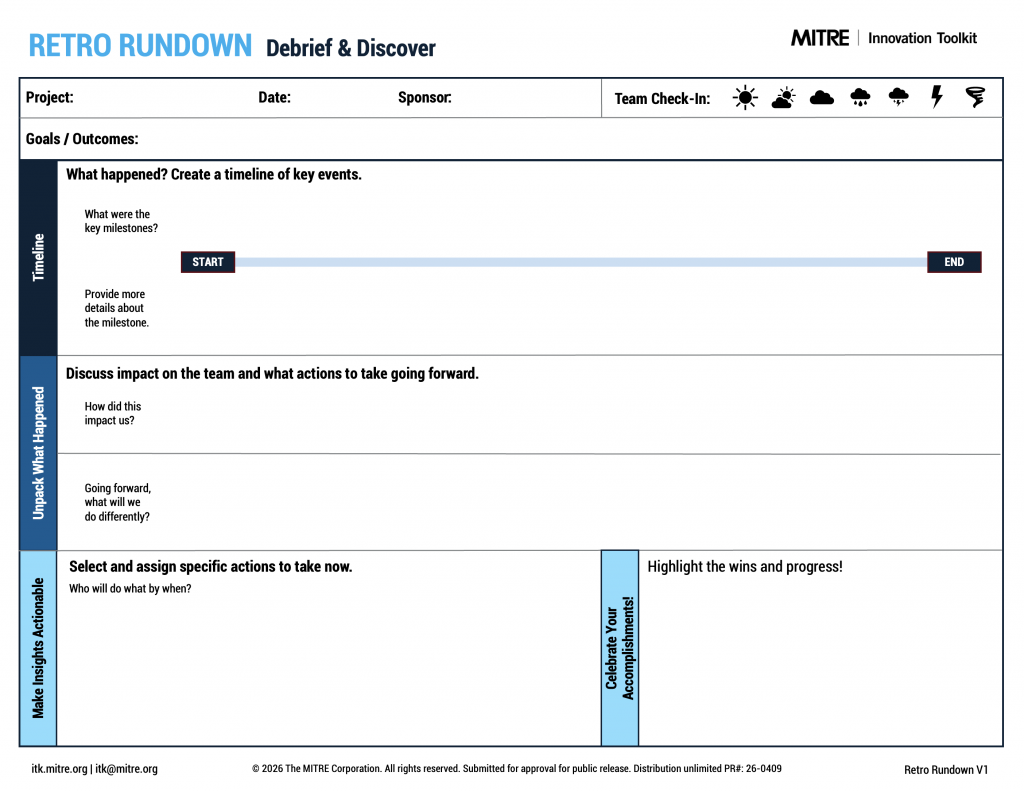
Retro Rundown Worksheet
How to do it
STEP 1
Event Data: Complete the basic information about the event, project, or activity.
STEP 2
Project Check-in: Each team member creates a sticky note with their name. Choose an icon that reflects how you’re feeling about the project and place it under your sticky. Invite everyone to share a brief explanation.
STEP 3
Timeline: Create a high-level timeline of key milestones to establish a shared baseline and surface what worked, what didn’t, and why.
- Pro tip! Focus on the most important milestones of your work.
- Add the start date on the left and today’s date on the right (replace the text in the yellow boxes).
- As a group, choose 3-5 key milestones and add them to the white boxes above the timeline. Prioritize decision points and major actions—not just outcomes.
- As a group, discuss and capture additional context and details below the timeline.
STEP 4
Unpacking What Happened: Discuss themes and impacts to identify what to do differently going forward.
- Pro tip! Start with what matters most. If you only had time to address one thing, what would it be?
- Move from insights to actions. Prioritize changes that are achievable and within the team’s control (or within the control of team leadership).
- Look for actions that improve a process or system so similar issues are caught earlier next time.
STEP 5
Make Insights Actionable For the highest-priority actions, agree on:
- What will be done (specific next steps)
- Who will lead it
- When progress will be reviewed (check-in date)
STEP 6
Celebrate Your Accomplishments! Don’t focus only on gaps. Take time to recognize what went well and where the team made progress.
Benefits
- Creates shared understanding by helping the team align on key events, milestones, and decision points through a common timeline.
- Turns lessons into action by requiring teams to identify what they will do differently, assign owners, and establish timelines for follow-up.
- Balances improvement with recognition by encouraging teams to celebrate accomplishments and reinforce successful practices alongside discussing challenges.
Challenges
- Can become a blame-focused discussion if facilitators do not maintain a learning-oriented, psychologically safe environment.
- May oversimplify complex issues when teams focus only on major milestones and miss underlying causes or contributing factors.
- Requires disciplined follow-through since identified actions lose value if owners are not held accountable or progress is not reviewed later.
Combine With
- Problem Framing -> Why did the highest-priority issue occur?
- Stakeholder Map & Matrix -> Who needs to be involved differently?
- Premortem -> How do we prevent similar failures next time?